

For people leaving, or thinking of leaving, the emergency services
What you did in the job counts for more than you think.
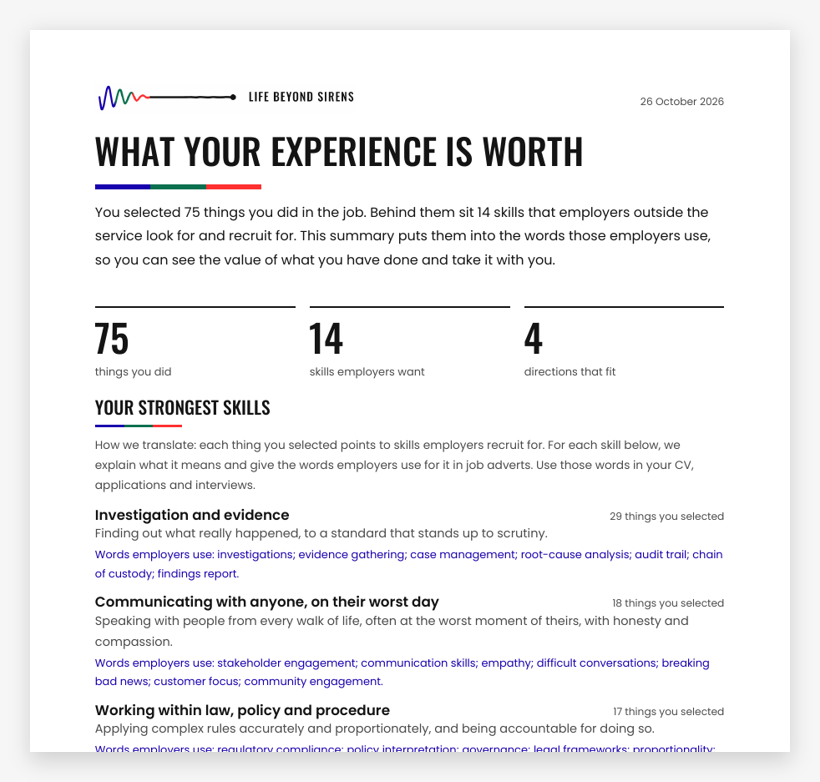
Whether you joined at 18 or after another career, and whether you served five years or thirty, your experience is worth more outside the service than most people realise. Sirens to Horizons helps you see what it is worth, describe it in words employers understand, and take the next step with confidence. Free, practical, and built with people who have made the move.
Start with the Skills Translator See where it could take you
Where are you now?
Still serving and thinking about it
Leaving soon
Already left
What you will find here


Built by people who have served
Sirens to Horizons is built by Richard Goold and Hannah Cooper, who both served in the police and made the move themselves, with people from across the emergency services reviewing each part before it goes live. We are building it in the open: the police first, then fire and ambulance, now added, with Coastguard and search and rescue next. It is free for everyone and shaped by everyone: if something is missing or does not ring true, tell us.
Why this matters, across the emergency services
Every year, thousands of people leave the police, fire and ambulance services: some after a full career, many after only a few years. Most leave with skills employers want, and very little help to show it.
police officers in England and Wales left in a year: 9,240 people, about 25 a day. Six in ten who resigned had served less than five years.
Home Office, Police workforce, England and Wales, March 2026 (6.3%)
fire and rescue staff in England left in a year: 3,814 people. Two in three on-call firefighters who left chose to resign.
Home Office, Fire and rescue workforce statistics, England, year to March 2025 (8.5%)
ambulance staff left their service in a year, and over a quarter of paramedics said they would leave as soon as they found another job.
NHS Workforce Statistics, year to June 2022, via Nuffield Trust (10.3%), the latest national rate; NHS Staff Survey 2021, via Nuffield Trust
police leavers said their force gave them no support when they left. Support across the other services is thinner still.
Oscar Kilo leavers survey, 2024 (163 people)
Still serving and weighing it up
Thinking about leaving is not the same as deciding to. Looking at what is out there, what your experience is worth and what it might pay can help you make the choice that is right for you, whichever way it goes. The skills that travel best can be built while you serve.
Five, ten, twenty or thirty years served
A few years in and ready for something new, leaving through injury or ill-health, or retiring after a full career. Whether you want full-time work, something part-time or a mix of roles, your experience of handling people and pressure is rare.
You may already hold more than you think
If you joined through a degree apprenticeship, you may hold an honours degree. Many people hold management, first aid, driving or instructor qualifications from their training. Universities can count service experience towards a degree.
Will the numbers add up?
For most people, the first question is whether a move is financially possible. With experience, roles in investigations, emergency planning, fire safety and financial crime can pay as much as many people earn at the top of their scale in the service, and some pay more. Future opportunities shows typical pay for each area and how it compares.